Biophilic Design: How to Bring the Outdoors In
We spend 90% of our time indoors. We move from air-conditioned houses to cars, to offices, and back again. We live under artificial lights and stare at glowing screens. Somewhere along the way, we lost our daily connection to the wild.
This disconnection has a cost. Studies consistently show that separating ourselves from nature increases stress, lowers productivity, and affects our mood.
This is why "Biophilic Design" is more than just a trend. It is a movement. It is the practice of designing our homes to reconnect us with the natural world.
You don't need to build a living wall or turn your home into a greenhouse to get the benefits. At Inframe, we believe the easiest way to bridge the gap is through "Visual Immersion."
The Science of "Forest Bathing" at Home
In Japan, there is a medical practice called Shinrin-yoku, or "Forest Bathing." It isn't hiking or exercise; it is simply being calm and quiet among the trees.
The science is fascinating: looking at fractals (the repeating patterns found in leaves, trees, and waves) physically lowers cortisol levels in the brain.
You can bring this physiological effect into your home with forest wall art.
A large-scale print of a misty woodland or a sun-drenched canopy acts as a window. When your eyes need a break from a laptop screen, resting them on deep greenery triggers a relaxation response. It is a visual deep breath.
Room-by-Room: Where to Use Nature Art
Biophilic design isn't just for the living room. Here is how to use nature to hack the "energy" of different rooms:
1. The Home Office (Focus & Productivity) White walls are terrible for creativity. They cause eye strain and fatigue.
-
The Fix: Place a piece of nature wall art behind your monitor or on the wall you face. Green is the color of focus. It is restful to the eye but keeps the brain alert. A detailed landscape photography print gives your mind something to "wander" through during thinking breaks, which actually boosts problem-solving.
2. The Bathroom (The Spa Effect) Bathrooms are often cold, lots of tile, glass, and porcelain.
-
The Fix: Warm it up with desert wall art or tropical tones. A framed print of sand dunes or warm rocks contrasts beautifully with cool white tiles, instantly turning a sterile bathroom into a warm spa environment.
3. The Bedroom (The Sanctuary) Here, you want low-stimulation images.
-
The Fix: Avoid high-contrast black and white here. Go for "Low-Vibe" nature. Soft mist, calm water, or coastal wall art with desaturated blues. You want the visual equivalent of a lullaby.
Beyond the Green: Earth Tones and Texture
Nature isn't just trees. Biophilic design also encompasses the "Earth Element."
If your home style is more Boho or Minimalist, you might find bright green too intense. This is where you lean into Earth Tones.
-
Bronze & Rust: Found in canyon and desert prints.
-
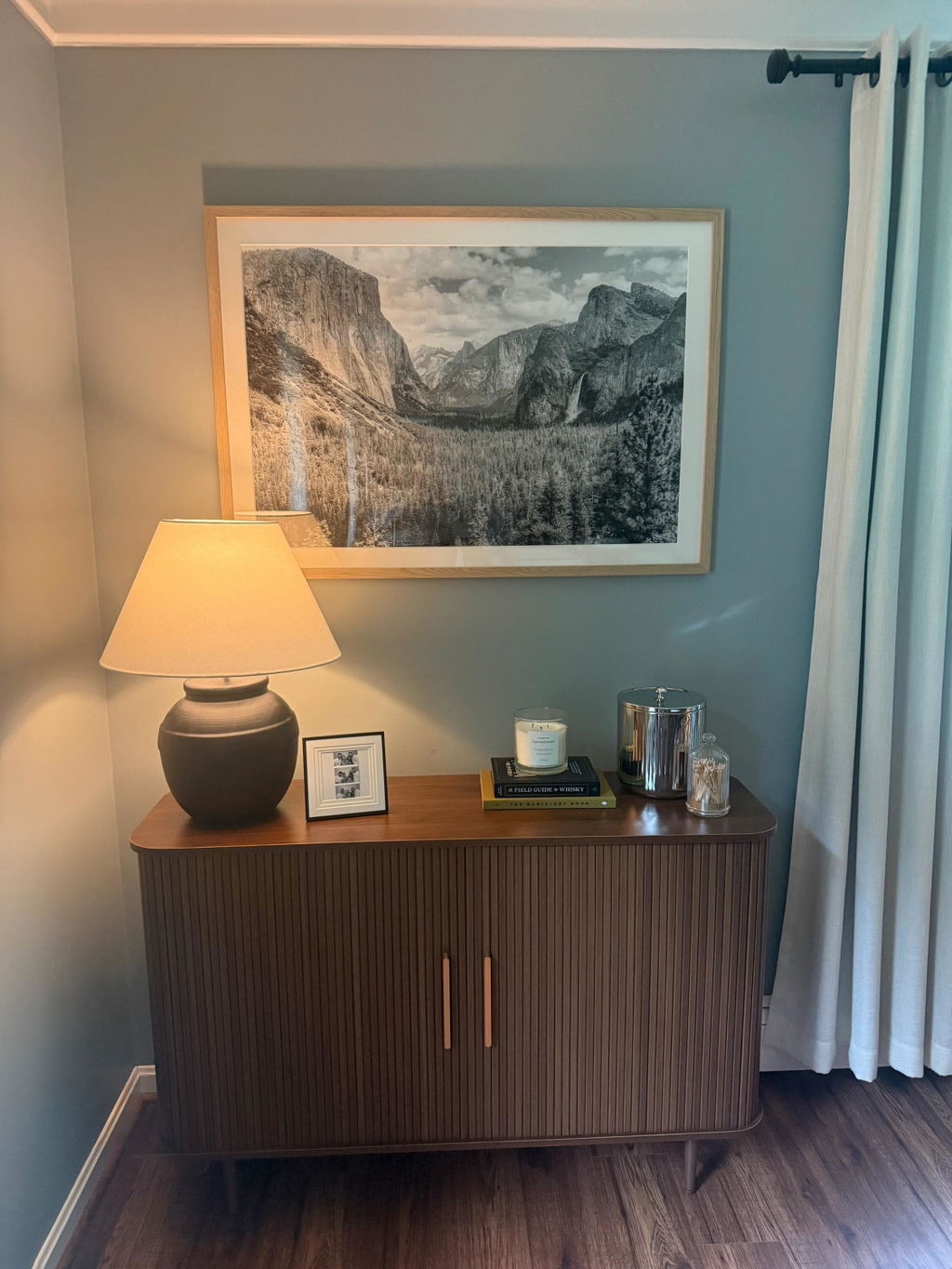
Stone & Slate: Found in mountain peaks.
-
Sand & Beige: Found in coastal dunes.
High-definition landscape wall art captures the texture of these elements. When you see the rough grain of a rock or the softness of moss in a print, your brain "feels" that texture. It adds a layer of sensory richness that a flat painted wall simply cannot match.
The "Fake Window" Technique
Not everyone is lucky enough to have a view of a park or the ocean from their window. Many of us look out at a brick wall or a street.
You can create your own view.
By placing a large framed art piece in a hallway, a windowless basement, or a small apartment, you trick the eye. You expand the horizon. This is known as "perceived space." A path leading into a forest creates depth where there is none.
Start Small, Dream Big
Bringing the outdoors in doesn't require a renovation. It starts with intention.
Look around your home. Where does the energy feel "stuck" or "sterile"? That is your candidate for a touch of nature. Whether it is a single framed fern or a massive mountain panorama, inviting nature inside is the healthiest design decision you can make.
FAQ
Does nature art work in modern, industrial apartments?
It is actually essential there. Industrial spaces (concrete, brick, metal) can feel cold. Adding a large piece of forest wall art provides the necessary organic contrast (Soft vs. Hard). It makes the space feel livable rather than just stylish.
Which frame suits nature photography best?
We love natural wood frames (Oak, Maple, or Walnut) for nature prints as they continue the organic theme. However, if you have a very modern home, a thin white frame can make green foliage "pop" and look very clean and contemporary.
How do I match art with my house plants?
Great question! You don't want to "match" exactly. If you have lots of dark green plants (like Monsteras), try art with lighter, mistier greens or contrasting earth tones (like Desert/Sand) to let the plants stand out. If you have no plants, go for deep, lush green art to fill that void.