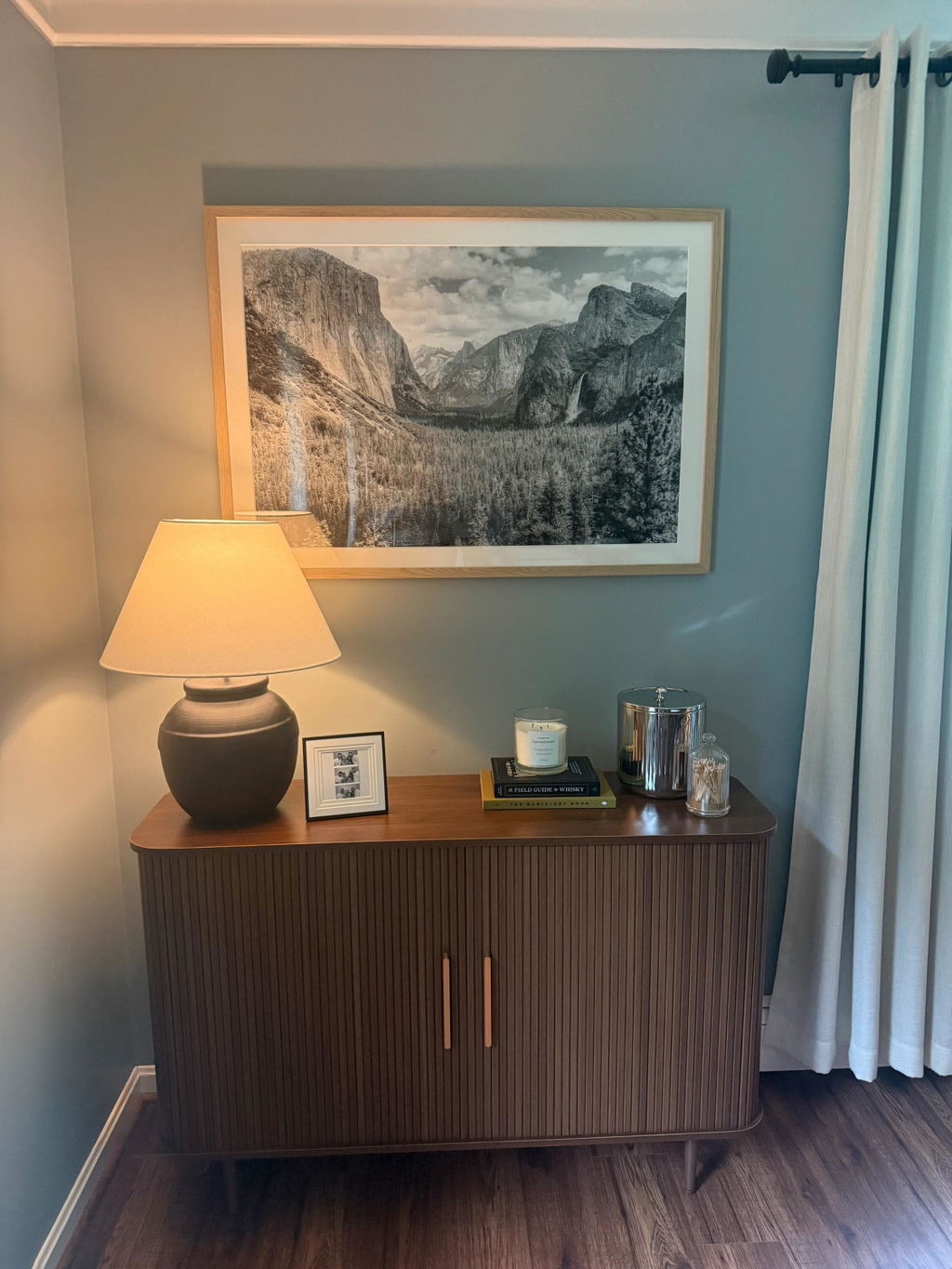
Landscape Photography Prints: How to Choose the Right Scene for Your Space
The right landscape photography for your space depends on one thing more than anything else: whether the photograph has a point of stillness.
Not stillness as in nothing is moving. Stillness as in the image has a visual center of gravity, a place where the eye can rest, return to, and rest again. Without it, a landscape photograph on a wall creates a faint sense of unease after a few months. You cannot always say why. You stop looking at it. That quality is what to look for before anything else.
What "A Point of Stillness" Actually Means
A photograph of breaking waves is not still. The viewer's eye is always catching the frozen moment of impact, re-evaluating it, looking for what comes next. For a bathroom or a hallway, this tension can work. For a wall you sit opposite every evening for years, it exhausts.
A photograph of the horizon line of the Pacific at dawn, where the water is long-exposed into silk and a single rock breaks the surface, is still. The eye knows exactly where to be. It rests there. The image rewards looking the same way on day three hundred as it did on day three.
The distinction is not about subject choice in a simple categorical sense. It is about what the photographer chose to do with the subject. A mountain range can have this quality or not, depending on how it was composed, what time of day it was shot, and what the light is doing. A coastal scene can have it or not. A forest can have it or not.
When you are looking at landscape photography prints for a wall, the first question is not "do I like mountains or do I like the ocean." The first question is "does this image give my eye somewhere to land."
The nature photography collection and the mountain wall art collection show this range clearly. Within each collection, some images have this quality and some do not. It is immediately visible once you are looking for it.
The Three Visual Qualities That Separate Strong Landscape Photography from Filler
Specificity of light. Intentional horizon. Tonal depth.
Specificity of light is the most important of the three. Dawn and dusk light in a landscape photograph is not a cliché. It is what it is because no other light does the same thing. The oblique angle creates shadows that reveal the texture of terrain. The color temperature is specific and unmistakable. A landscape photograph made in the flat midday light of a clear day records the scene. A landscape made at the right moment in the right light interprets it.
An intentional horizon means the photographer chose where to place it. A horizon at the center of the frame divides the image evenly between sky and land, and the eye reads it as an absent decision. A horizon placed deliberately, whether high to emphasize the land or low to give the sky room, tells you that someone was paying attention. The forest wall art collection shows how this works in forest subjects, where the "horizon" becomes the point at which the canopy closes. The decision is the same regardless of terrain.
Tonal depth is what separates a photographic print that looks like a photograph from one that looks like it could have been shot on a phone. It is the presence of genuine shadow detail, genuine highlight detail, and a full range between them. You can see this immediately in any print at close range. If the shadows are pure black with no information in them, and the bright areas are flat with no texture, the tonal range is compressed. This is a characteristic of low-quality printing as much as low-quality photography. It is what archival pigment inks on fine art paper are specifically designed to preserve.
The Scale Question for Landscape Photography
Landscape photography is a horizontal subject in most cases. The eye moves across the frame the same way it moves across a physical landscape, left to right, far to near, horizon to foreground. This movement needs room. Small landscape prints interrupt the movement before it has started.
A minimum of 70x100cm for a single print on any main wall. For walls wider than 160cm, a multi-panel set nearly always works better than a single very large piece. The Redwoods Path Set of 3 shows how a forest subject works when spread across three panels. The eye moves across the image with the same fluid quality it would across the physical subject.
For the measuring process and the two-thirds rule for furniture-to-print proportions, the wall art sizing and hanging guide is the most useful reference.
How Different Landscape Subjects Behave in Interior Spaces
This is worth understanding before choosing a subject type, because the relationship between the photography and the room changes significantly across terrain.
Mountain landscapes bring mass and verticality into a space. They suit rooms that can hold visual weight. A large mountain panorama on the main wall of a living room reads as an anchor. It does not move. This suits rooms where the other elements are also considered and relatively still. A bedroom. A study. A living room where the furniture is substantial. The mountain wall art collection has the range, from full panoramic prints to single-peak studies with strong atmospheric quality.
Desert landscapes introduce warmth and openness simultaneously. The palette of a desert at golden hour, burnt orange and long blue shadow, suits interiors with warm material palettes. Stone floors, linen textiles, pale render. The desert wall art collection shows how much visual range exists within this terrain type. The same landscape reads completely differently at dawn versus golden hour.
Forest subjects create intimacy and depth rather than openness. A forest interior does not give the eye an open horizon. It gives it a progression through vertical elements toward a light source. This suits rooms where enclosure is welcome rather than unwanted. A bedroom. A home office where the forest interior suggests a quality of focus. The forest wall art collection includes both open canopy and dense woodland subjects.
Coastal landscapes occupy the middle ground. A wide coastal shoreline with a long horizon gives a room the sense of open space that a mountain panorama does, but with a quality of movement in the water that mountain subjects rarely have. The distinction between the two is the degree of stillness, which comes back to the opening point. For more on the specific qualities of coastal photography, the coastal wall art guide covers it in full.
Black and White Landscape Photography: When It Works Better Than Color
The case for black and white in landscape photography is specific. It is not simply a matter of timelessness or style.
Color in a landscape photograph is literal. It is the color of that light on that terrain on that day. When the color is exceptional, this literalness is an advantage. A desert at golden hour has color that cannot be improved by removing it. A coastal scene at dawn with a sky full of gradient orange and blue is a specific record of a specific morning.
Black and white landscape photography removes the literal and leaves the architecture. A mountain range in black and white becomes a study in mass, edge, and atmosphere. A forest becomes a study in vertical structure and the way light moves between trunks. These are genuine qualities of the subject, and removing color can clarify them.
The practical consideration: black and white landscape prints suit a wider range of interior palettes because they do not introduce a competing color. A color desert print in a room with cool, grey tones creates tension. The same subject in black and white does not. The black and white wall art collection shows landscape, coastal, and forest subjects in this format across a range of subjects.
The right landscape photography for a wall is the photography that gives the eye somewhere to rest, that was made in specific light by someone who was paying attention, and that holds up differently each time you look at it.
Browse the nature photography collection for the full range of landscape subjects, or go directly to the collections by terrain: mountain, forest, and desert.
FAQ
What makes landscape photography prints worth buying?
The photography should have specificity of light, an intentional composition, and a point of visual stillness. These are the qualities that make a landscape photograph hold up over time on a wall rather than becoming invisible after a few months. A photograph that records a place is different from a photograph that interprets it.
What size landscape photography print should I get?
70x100cm is the practical minimum for a single print on a main wall. For walls wider than 160cm, a multi-panel set is usually more effective than one very large piece. Landscape subjects are horizontal compositions that need room. Going too small is the most common mistake.
Does black and white or color work better for landscape photography?
It depends on the subject and the room. Color works best when the palette of the original light is exceptional and the room's tones can absorb it. Black and white removes the literal color and clarifies the architectural qualities of the terrain. It also suits a wider range of interior palettes because it does not introduce a competing color.
Which landscape subject works best in a living room?
Subjects with a strong point of visual stillness and a quality that rewards long-term looking. Mountain panoramas, wide coastal horizons, and open forest subjects with a clear light source all work well. High-energy dynamic subjects, breaking waves, storm light, heavy atmospheric movement, are better suited to spaces where you spend less time sitting and looking.
Can I mix different landscape subjects in one room?
Yes, provided there is a consistent logic connecting them. Either all the same terrain type, or all the same palette, or all the same format. Mixing a coastal horizon with a mountain panorama with a forest interior in one room tends to pull in three different directions unless there is a strong material or tonal consistency in the prints themselves.
What is the difference between landscape photography and nature photography?
Landscape photography treats terrain as the primary subject. Nature photography is broader and includes botanical, wildlife, macro, and abstracted natural subjects. All landscape photography is nature photography, but not all nature photography is landscape. For a fuller picture of the broader category, the nature photography guide covers the full range.