Nature Photography Prints: What to Look For, What to Avoid, and Where to Put Them
Most nature photography sold online is forgettable. Not bad, exactly. Just the kind of image that fills a wall without doing anything to the room. You stop noticing it within a week. It becomes wallpaper.
The prints that actually work are a different thing. You see them in a well-designed room and they have weight. They slow you down. They make the space feel quieter, or wider, or more considered than it did before the print arrived.
The difference between those two outcomes is not about subject matter. It is about specificity, print quality, and knowing what a room can hold. This guide covers all three.
What Separates Good Nature Photography from Generic Filler
Here is a useful question to ask when you are looking at a nature photography print: does this image feel captured or constructed?
Constructed images are everywhere. They are technically fine, often pretty, and made to appeal to the broadest possible audience. A generic sunset over water. A mountain with perfect symmetry. A bird against a clean background. These images were designed to be inoffensive. They achieve that goal and nothing else.
Captured images are the ones made by someone who was in a specific place at a specific moment and paid attention to the light. A patch of morning fog sitting just above a river at 7am in November. A wave breaking in a way that only happens at one particular point on a beach. You cannot replicate it by showing up somewhere similar with a camera. The photographer waited for it, recognized it, and made the shot.
That specificity is what gives a print presence on a wall. When you browse nature wall art, look for that quality. Ask yourself: does this feel like a place, or does it feel like an idea of a place?
Forest and Woodland Photography
Forest prints are among the most versatile in the nature photography category. The light in a forest interior does something unusual: it fractures. It comes through the canopy in fragments, landing on bark and moss and the forest floor in ways that change completely depending on the season, the weather, and the hour.
Early morning light in a dense forest has a quality of not-quite-revealed. The mist is still present, the shadows have not fully lifted, and the scene holds a kind of suspense. That quality translates onto a wall with remarkable fidelity if the print is done well.
Golden hour in a forest is warmer, more welcoming. The trunks glow. The whole scene leans toward amber. It suits living rooms and dining rooms that have warm material palettes.
What does not work is a forest photograph without depth. All midground, no foreground pulling you in, no background giving the scene space. Printed large, a flat forest photograph looks like a backdrop. Look for images where the eye travels, where there is something interesting in every plane of the composition.
Botanical Photography Prints
Close-up botanical photography has had a long run in interior design, and deservedly so. A leaf held against diffuse light, with its veining visible through the surface. A seed head photographed so close that the geometry becomes abstract. These images bring the visual language of the natural world indoors at a scale that feels intimate rather than panoramic.
Botanical photography prints work particularly well in smaller formats. A series of three or four prints, 30x40cm or 40x50cm, with consistent framing and a generous white mat around each one, can cover a wall in a way that feels considered rather than cluttered.
The subject does not need to fill the frame. In botanical photography, space around the subject is often doing more work than the subject itself. A single fern frond against a pale background, with room on all sides, can have more presence than an image packed edge to edge.
One pairing that consistently works: botanical prints with natural material interiors. Linen, raw timber, rattan, unfinished stone. The visual language matches. The botanical prints feel like they belong rather than being placed.
Wildlife Photography Wall Art
Wildlife photography is the category with the highest ceiling and the longest list of things that go wrong.
At its best, the subject matter is unlike anything else on a wall. A humpback whale breaking the surface with a coastline behind it. A barn owl in the half-second before landing. These images have an energy and emotional specificity that landscape photography rarely matches.
The problems are scale and composition. A cheetah at full sprint is extraordinary as a photograph. On a dining room wall, you will look at it every day for the rest of your time in that house. High-drama wildlife subjects are exhausting over time. The wildlife prints that work best in residential spaces tend toward quieter moments. A bird in careful stillness. A marine animal photographed with space around it, not filling the frame.
The other issue is clinical photography. Technically correct, shot in perfect conditions, the subject perfectly exposed and positioned. These images belong in nature documentaries, not on walls. Good wildlife photography for a home has a feeling for light and composition beyond just the subject. The shot asks you to look at it as a photograph, not just as evidence of an animal.
Landscape Photography Prints
Landscape photography is broad enough that it deserves its own guide, but within the context of choosing nature prints, one variable matters above all others: orientation.
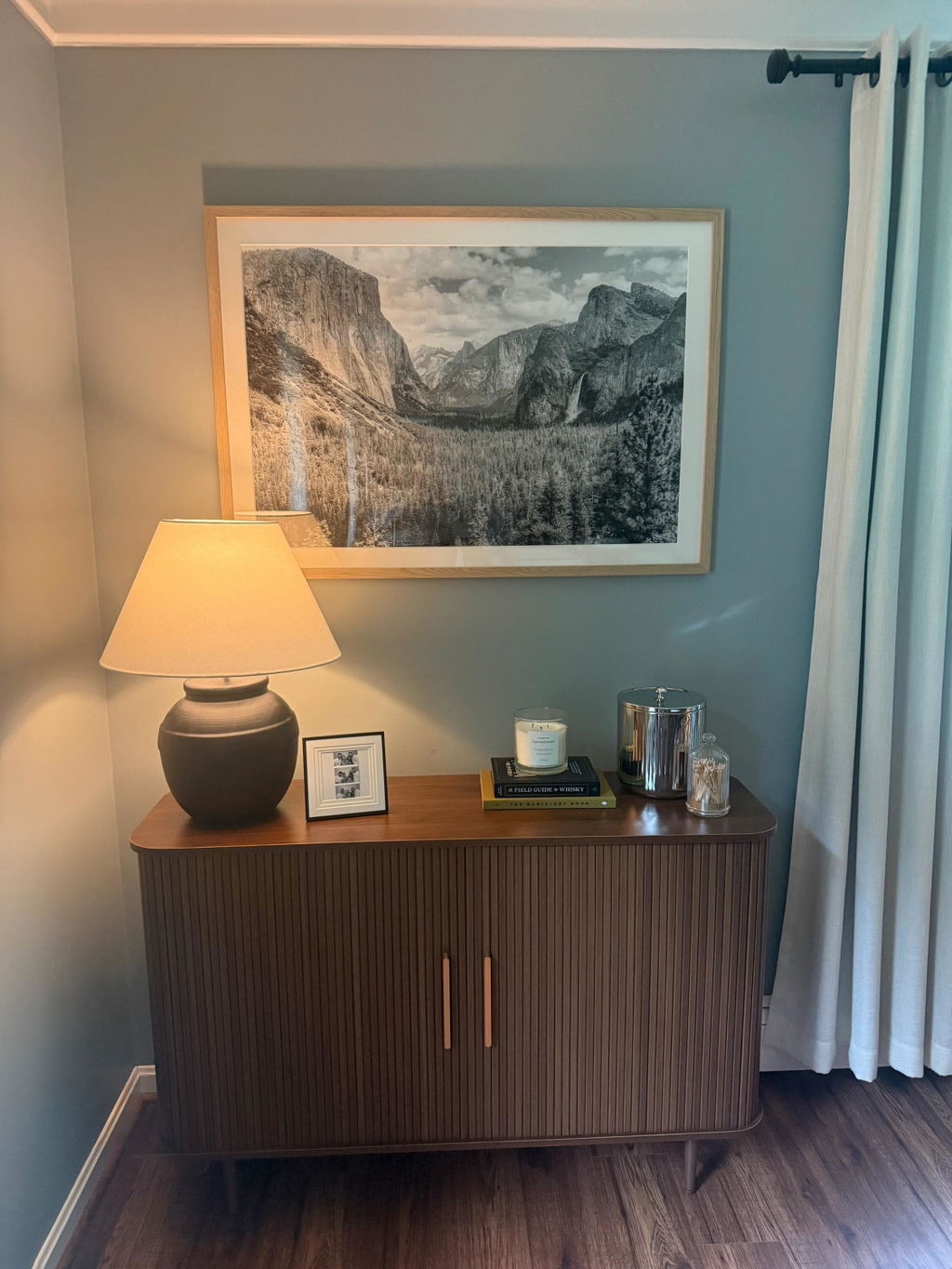
Wide horizontal landscape prints work above furniture, along long walls, and anywhere you need to push the horizontal dimension of a room. A mountain range. An open grassland. A river bending through a valley. These compositions breathe laterally, and a room benefits from that.
Vertical landscape prints, a waterfall, a cliff face, a stand of tall conifers shot from the base looking up, work in narrow spaces. A hallway, the wall beside a doorway, a bathroom corner. The vertical format suits spaces that already have height.
Browse the landscape collection with orientation in mind before anything else. It narrows the choice quickly and keeps you from buying a horizontal print for a vertical wall and wondering why it does not sit right.
Placing Nature Photography by Room
Living room. This is where scale matters most. A nature print on the main wall of a living room needs to earn its position. For most sofas and most main walls, that means nothing smaller than 70x100cm, and often larger. Coastal and landscape subjects carry that scale well. Wildlife subjects need more care. Choose something that gives the eye somewhere to rest.
Bedroom. The bedroom is the one room where the priority is calm above everything else. Soft light, muted tones, subjects without visual urgency. A misty forest. A still mountain lake at dawn. A pale botanical close-up. The wall above the bed is not the place for your most dramatic shot.
Bathroom. People underestimate how much a print can do in a bathroom. A well-chosen botanical or coastal nature print in a 40x50cm or 50x70cm format, properly framed and positioned away from direct steam, transforms a purely functional room into something better. Frame with sealed timber or metal and UV-protective glass.
Home office. There is research on this. Natural imagery in a workspace reduces mental fatigue more reliably than abstract or urban subjects. A forest interior or a wide open landscape in a home office is not a decorative choice. It is doing something. Choose something with depth, a scene you can mentally step into in the thirty seconds you need to look away from a screen.
Print Quality: The Part That Most Listings Skip
Nature photography rewards good printing more than almost any other category. The reason is tonal subtlety. The gradation from shadow to filtered light in a forest, the range of greens across a single fern, the almost-nothing detail in a shadowed rock face. These things survive on an archival print. They disappear on a cheap one.
Archival pigment inks are the standard for fine art photography. They produce a broader tonal range than dye-based inks and do not fade quickly in rooms with natural light exposure. If a listing does not mention ink type, that is information.
Matte fine art paper suits soft, quiet subjects. Botanical prints, overcast forest photographs, landscapes without strong contrast. The surface keeps the mood calm.
Lustre or satin paper is a good all-rounder. More tonal range than matte, without the surface reflections of gloss. Works across most nature photography subjects.
Metallic paper suits high-contrast subjects. Wet rocks, water in motion, iridescent feathers. The surface quality adds to the image rather than competing with it.
For framing, light natural timber suits botanical and woodland subjects. Black or dark timber works for high-contrast landscapes and wildlife. When uncertain, white frames keep the attention where it belongs: on the print.
Our guide to choosing wall art covers framing and sizing decisions in detail if you want to work through those choices before buying.
Key Takeaways
Start with the question of whether an image feels like a specific place or a general impression of one. If it is the former, you are in the right territory. Then get the scale right for the room, choose a print format that suits the subject, and do not compromise on print quality. The tonal subtlety in good nature photography is exactly what disappears on inferior materials.
Browse the full nature photography print collection and take your time with it.
FAQ
What is nature photography wall art?
Fine art prints made from photographs of natural subjects: forests, plants, wildlife, landscapes, and botanical close-ups. At the quality end of the category, these are archival prints from photographs made with deliberate artistic intent, not stock imagery chosen for broad appeal.
Which rooms suit nature photography prints best?
Most rooms work. Larger landscape and wildlife prints suit living rooms and bedrooms. Botanical and coastal subjects suit bathrooms and studies. The subject and its tonal register should guide placement more than any fixed room rule.
What size prints work on a main wall?
For a living room or bedroom main wall, 70x100cm is a practical minimum. For walls wider than 150cm, a multi-panel or triptych format in a landscape orientation handles the scale better than a single large print.
How do I tell if a nature print is archival quality?
Look for explicit mentions of archival pigment inks and fine art paper. Paper brands like Hahnemühle and Canson Infinity are reliable indicators. If a listing does not specify the printing process, ask before ordering.
Are nature photography prints safe for bathrooms?
Yes, with correct framing. A sealed frame with UV-protective glass, positioned away from direct steam, protects an archival print well. Botanical and soft coastal subjects are the most popular choices for bathroom placement.
What is the difference between nature photography and landscape photography?
Landscape photography is one subset of nature photography. Landscapes focus on outdoor environments at an environmental scale. Nature photography also includes close-up botanical work, wildlife portraiture, macro subjects, and forest interiors that do not read as traditional landscapes but share the same natural subject matter.